
How to Get Your First 10 Paying MicroSaaS Customers
Your first ten customers are a research project with revenue attached. You need to learn who has the problem, what they do today, and what makes your product worth paying for. A big launch rarely answers those questions as clearly as ten conversations with the right buyers.
This guide uses an illustrative product: a tool that turns a freelance designer's approved proposal into a client onboarding checklist. The numbers below are planning examples, not reported results or conversion benchmarks.
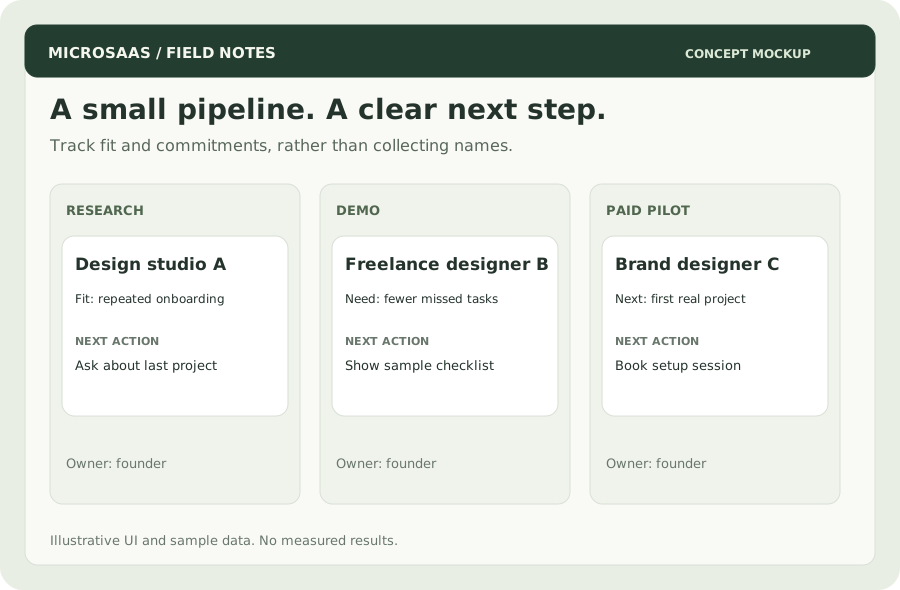
Concept mockup: a small prospect board. Every prospect has a reason to be there and one next action.
1. Choose a buyer you can actually reach
“Freelancers” is too broad for your first outreach list. Start with freelance brand designers who manage several client projects at once and already use a repeatable onboarding process.
Write a one-sentence hypothesis:
For freelance brand designers, turning an accepted proposal into a checklist takes repeated admin work. Our tool creates an editable checklist from that proposal, so the designer can start the project without rebuilding the same tasks.
Before polishing your homepage, ask five people how they handle this today. Ask about the last actual project, not whether they like your idea:
- What happened immediately after the client accepted?
- Where did you copy the tasks from?
- What got missed, and what did that cost you?
- Who decides which tools you use?
- What would prevent you from trying another workflow?
If nobody can describe a recent problem, revisit your niche before writing more features.
2. Build a list of 30 relevant prospects
Use your existing network, professional directories, and communities where people explicitly discuss the workflow. Look for evidence of fit: a portfolio, a recent process question, or a public description of how they work. A scraped list with job titles alone gives you little to talk about.
Download the prospect tracker. Record the fit signal, current workaround, stage, last contact date, and next action. Avoid storing client documents or sensitive notes in an outreach spreadsheet.
Paul Graham's Do Things That Don't Scale argues for recruiting early users manually. For a solo founder, that means spending time with a few relevant people before automating acquisition.
3. Send a small, specific invitation
Here is a template to adapt when there is a genuine connection or relevant context:
Hi [name], I saw your post about onboarding design clients. I'm testing a tool that turns an accepted proposal into a project checklist. How do you handle that step today? If it is a recurring headache, I can show a short example using a made-up proposal.
Do not pretend you have read their work when you have not. Keep the first message short. If someone declines, stop. A follow-up should add context or a useful example rather than repeat the pitch.
4. Demo the job, then ask for a paid commitment
A useful 15-minute demo has three parts:
- Five minutes: understand their current process and an upcoming project.
- Five minutes: show the input, editable output, and the one task your tool removes.
- Five minutes: agree on a next step, including price and what success means.
Use a fictional document first. If they want to test their own material, explain storage and deletion before accepting it.
An illustrative pilot offer might be €25 for a month covering five projects, with personal setup help. This is a test price, not a recommendation for every SaaS. State what happens after the pilot and how they cancel. Do not call a free trial a paying customer.
A useful question is: “Would you use this on your next project at this price?” If the answer is yes, give them a working payment route and book the setup. If it is no, record the reason without negotiating every objection away.
5. Diagnose the stage that is failing
| What you observe | What to investigate next |
|---|---|
| Few relevant replies | Prospect fit, message clarity, or the channel |
| Replies but no demos | Whether the problem is urgent enough to spend time on |
| Demos but no payments | Missing value, switching cost, trust, or price |
| Payments but no usage | Setup friction and the first useful result |
| Usage but no renewal | Recurring value and the frequency of the problem |
For an illustrative funnel of 30 contacts, 12 replies, 6 demos, and 2 payments, contact-to-paid conversion is 2 / 30 = 6.7%. That arithmetic does not make 6.7% a target. With a tiny sample, the reasons behind each decision matter more than the percentage.
A two-week starting plan
- Days 1–3: choose the buyer, run five workflow conversations, revise the promise.
- Days 4–7: contact a small relevant batch and run the first demos.
- Days 8–10: onboard paid pilots personally; watch where they struggle.
- Days 11–14: review objections, fix one repeated issue, and ask active customers who else has the same problem.
Ten paying customers may take much longer than two weeks. The plan is a way to start learning, not a revenue deadline. Once the process works repeatedly, add search distribution or a useful free tool. First, earn a small number of real yeses.


