
When to Kill, Pivot, or Keep Building Your MicroSaaS
A quiet launch does not tell you whether the idea is bad. It can mean the wrong audience saw it, the promise was unclear, or people never reached a useful result. Equally, another month of features will not fix a problem nobody wants to solve.
Make the decision with a small evidence review. Separate what customers said, what they did, and what it costs you to keep learning.
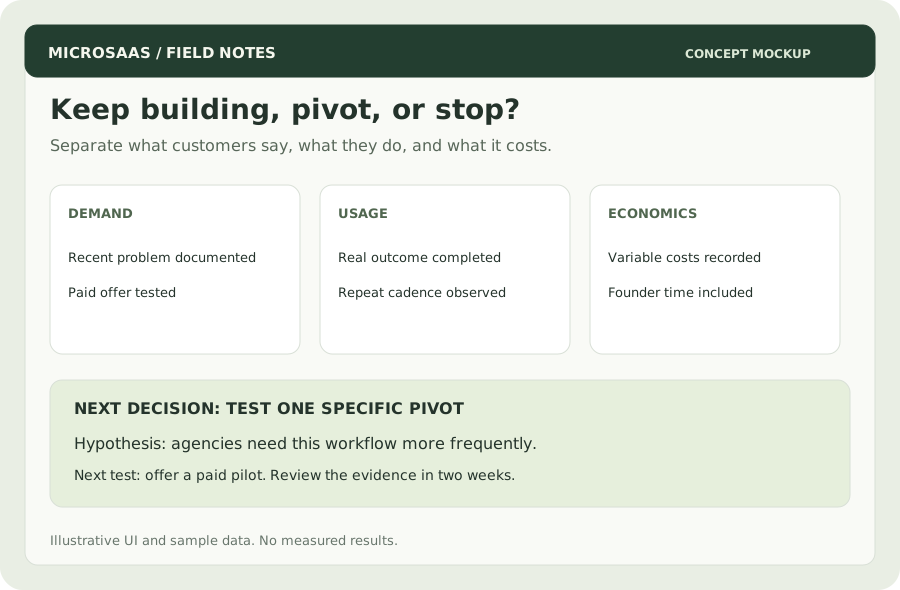
Concept mockup: a decision memo with uncertainty and a dated next test. It is not an automated score that decides your business for you.
First, define the hypothesis you are judging
Write down the buyer, job, promise, and price you have actually tested:
Freelance brand designers will pay €25 per month to turn accepted proposals into editable project checklists, because preparing those checklists repeatedly takes time and causes missed tasks.
This is an illustrative hypothesis. If your landing page targets all freelancers, the outreach targets agencies, and the product supports only designers, the evidence is mixed before you start.
Choose an observation window that fits the workflow. A monthly reporting product cannot prove repeat usage in three days. Decide the experiment length and your time budget before starting. Extend the window only for a specific reason, not because stopping feels uncomfortable.
Collect five kinds of evidence
| Evidence | What to record | What it can tell you |
|---|---|---|
| Reach | Relevant prospects contacted and qualified visits | Whether the hypothesis received a fair test |
| Urgency | Recent problem, current workaround, consequence | Whether the job matters now |
| Commitment | Paid pilots, purchases, agreed start dates | Whether interest survives a concrete offer |
| Usage | First successful outcome and repeat use | Whether the product delivers recurring value |
| Economics | Revenue, variable costs, support time | Whether you can afford the next stage |
Compliments and waitlist signups can help you find interviewees. They are weaker evidence than using the product for real work or paying for it. Do not combine them into one “traction” number.
Download the decision memo and fill it in before discussing another feature.
Keep building when the core job is working
Consider continuing when a specific buyer repeatedly uses the product, pays or makes a clear paid commitment, and describes the same valuable outcome. Even a few such customers can reveal a viable direction; they do not yet prove a large market.
Your next work should address the repeated bottleneck. If buyers love the output but setup takes an hour, improve onboarding. If active users refer peers but outreach fails, improve the message and prospect list rather than rebuilding the output engine.
Set a dated goal tied to behavior: “By the next review, help three new customers complete their first real checklist without a call.” This is more informative than “ship five features.”
Pivot when the evidence points to a different job
A pivot is a change to a specific part of the hypothesis: audience, problem, workflow, pricing, or distribution. Change one major assumption at a time when possible, so the next test can teach you something.
Illustrative example: designers rarely create new checklists, but small agencies do it every week and need team templates. You might test agencies and a shared-template workflow before building a whole agency management suite.
Write a pivot memo:
- What observation contradicts the original hypothesis?
- What repeated evidence supports the new buyer or job?
- What can be reused without forcing the old design into the new workflow?
- What small paid test would distinguish the new direction from wishful thinking?
Return to idea validation if the new promise has not been tested. A change of logo is not a new demand test.
Stop when the next test is no longer worth its cost
Stopping becomes reasonable when relevant buyers repeatedly lack urgency, no concrete offer produces commitment, and you have no specific new hypothesis supported by evidence. It is also reasonable when the project no longer fits your available time or finances.
No universal rule says “quit at 90 days” or “continue until €1,000 MRR.” A founder with existing income and a low-cost tool has different options from someone funding expensive inference and support from savings.
Before stopping, distinguish lack of demand from lack of exposure. Five unrelated visitors and no payments do not constitute a strong demand test. A series of conversations with qualified buyers, documented objections, and a clear paid offer gives you more useful evidence.
Include founder time in the economics
For a fictional month with €300 revenue, €70 payment and infrastructure costs, and 12 support hours valued at €25 per hour:
cash contribution before other expenses = €300 − €70 = €230
founder-time-adjusted contribution = €230 − (12 × €25) = −€70
This is a planning estimate, not an accounting profit calculation. It excludes tax and other expenses, and the hourly value is a choice. Separating cash from time prevents you from calling a support-heavy project effortless recurring revenue.
Can the support burden fall through one repeatable fix? Are customers willing to pay for the service level? If neither is plausible, more customers may make the workload worse.
End the review with one decision and one date
Choose continue, test a pivot, or stop accepting new customers and close carefully. Record the evidence, uncertainty, next action, and review date.
If you close a paid product, tell existing customers clearly, stop new billing at the appropriate point, provide an export route, and explain the closure timeline. Do not delete their work just because you have decided to move on.
The decision is not a verdict on you as a founder. It is a choice about where the next hour and the next euro are most likely to produce useful learning or customer value.


